The Complete Guide to Down Insulation

A Jöttnar technical guide

The Complete Guide to Down Insulation

Fill power, fill weight, hydrophobic down and what the numbers actually mean.

Down is one of the most remarkable materials in nature. Ounce for ounce, nothing in the world insulates better. A fistful of high-quality goose down, barely weighing anything, compressing to almost nothing, can keep a person warm at temperatures where the body would otherwise struggle to survive.

That's why it's been trusted for centuries. And why, in an era of advanced synthetics and technical membranes, the best mountaineers, climbers and alpinists still reach for a down jacket when the temperature drops and weight matters.

This guide explains everything you need to make a genuinely informed decision about down insulation - what it is, how it works, what the numbers mean, and what to look for when buying.

Down is the soft, fine layer of feathers that sits beneath the outer plumage of waterfowl - primarily geese and ducks. These clusters are not feathers in the conventional sense. They have no rigid shaft. Instead they're a three-dimensional structure of interlocking filaments that trap air, and it's that trapped air that insulates.

The down found in high-performance jackets comes almost exclusively from geese. Both are used in general outdoor jackets, but they're not equal.

Goose down produces larger clusters with better loft, higher fill power ratings and superior resilience over time. It has a neutral smell and a softer feel. Premium goose down is simply the best natural insulation available.

Duck down can reach good fill power ratings (700+), but the clusters are inherently smaller and it is less resilient. Duck down is more widely available and generally less expensive.

For serious mountain use, goose down is the right choice. All Jöttnar down jackets use goose down.

Fill power: what it means and why it matters

Fill power is the most commonly cited number in down jacket specs, and the most commonly misunderstood. It measures the volume, in cubic inches, that one ounce of down occupies when fully lofted. Higher fill power means larger, more resilient clusters that trap more air without adding bulk or weight.

What fill power does not tell you: how warm the jacket is. Warmth is a function of both fill power and fill weight — the actual mass of down in the jacket.

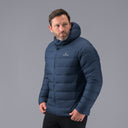
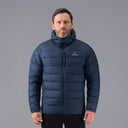
Fenrir Hooded Down Jacket

1 | 16

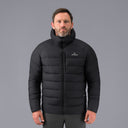
Fenrir Expedition-Grade Down Jacket


Colour
Size
View product

Fill weight: the number nobody talks about

If fill power is the quality metric, fill weight is the quantity metric, and the two together determine how warm a jacket actually is.

Fill weight is the total mass of down in a jacket, usually expressed in grams. A lightweight down jacket might use 80–120g of down. A serious expedition jacket might use 250g or more.

A useful way to think about it: fill power is the quality of your fuel, fill weight is how much fuel is in the tank. Both matter.

When comparing jackets, look at both numbers together. A 900 fill power jacket with 80g of down may be lighter and more packable than an 850 fill power jacket with 200g, but considerably less warm. 

Why does nobody talk about this? One reason is that manufacturers enjoy the fillpower headline - relying on the consumer to believe this is enough of a quality mark.

A less cynical reason is that down jackets have multiple different constructions to achieve different performance, use, and protection criteria; some are hybrid (using both down and synthetic in different areas of the same jacket). Some have hoods, some high collars, both of which will have down in them at different volumes between manufacturers. Some down jackets will have synthetic fill in the shoulder area to resists rucksack strap compression, or small amounts of synthetic fill in high moisture prone areas, such as the front zipper up collar into which we breathe vapour. So comparing fill weight across manufacturers helps the purchaser less than it might appear.

This second reason is why we don’t declare it either. Our jackets are engineered precisely to achieve defined use cases, which may not be achieved by simply loading up on down fill weight alone – the jacket must be tuned.We are happy to discuss fill weight with enquirers, where we can provide context. Just get in touch. 

A 900 fill power jacket with 80g of down may be lighter and more packable - but considerably less warm than an 850 fill power jacket with 200g.

The wet weather problem and how DownTek™ solves it

Down's one significant weakness is moisture. When down clusters get wet, the interlocking filaments collapse and clump together, losing their ability to trap air. A saturated down jacket can lose up to 90% of its insulating value.

Untreated down fails in under an hour of moisture exposure. DownTek™ treated down maintains performance for 1,500 minutes.

DownTek™ ZeroPFC™  is a PFC-free hydrophobic treatment applied to each individual down cluster that fundamentally changes this relationship. The treatment causes moisture to bead and roll off the clusters rather than being absorbed by them. Down treated with DownTek™:

  • Absorbs 33% less moisture than untreated down
  • Retains 66% more loft when wet
  • Dries significantly faster

It doesn't make down waterproof - nothing does - but it extends the performance window in marginal conditions considerably, and makes down genuinely viable in the wet, unpredictable weather characteristic of British and Alpine mountain environments.

All Jöttnar down jackets use DownTek™ treated down.

The Jöttnar down range

Asta Lightweight Down Gilet 29% off

£189.00
Regular price £269.00 Minimum price £189.00

Fenrir Expedition-Grade Down Jacket 30% off

£229.00
Regular price £329.00 Minimum price £229.00

Thorne Down Jacket 33% off

£199.00
Regular price £299.00 Minimum price £199.00

Glossary

RDS
Responsible Down Standard. Certification confirming ethical sourcing.
Baffle
Channels within a jacket that contain the down and prevent migration.
Fill weight
Total mass of down in a jacket (grams). Combined with fill power determines warmth.
Loft
How much a down cluster expands when uncompressed. Greater loft = better insulation.
DownTek™
PFC-free hydrophobic treatment applied to individual down clusters.
Fill Power
Volume (cubic inches) one ounce of down occupies when fully lofted. Quality metric.
Down-to-feather ratio
The proportion of down clusters to feathers. Higher down content = better insulation, lighter weight.