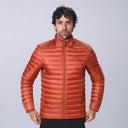
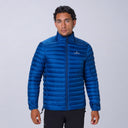
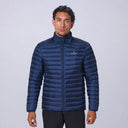
Down vs Synthetic Insulation: The Honest Guide

A Jöttnar technical guide

Down vs Synthetic Insulation: The Honest Guide

Down or synthetic insulation? The honest comparison. Warmth, wet weather, packability and durability.

Most guides on this topic will tell you down is better when it's dry, synthetic is better when it's wet, and leave you to figure out the rest. That's technically accurate and practically useless.

The real answer depends on what you're doing, where you're doing it, and how you're layering. We've worn both in everything from Scottish winter to the Himalaya. Here's what we actually know.

What you're really comparing

Before getting into specifics, it helps to understand what down and synthetic insulation actually are and what both are trying to do.

All insulation works the same way: it doesn't generate heat, it prevents your body heat from escaping. It does this by trapping air in a matrix of material close to your body. The more air a given weight of insulation can trap, the more efficiently it insulates.

Down is a natural material - the fine, three-dimensional clusters found beneath the outer feathers of geese and ducks. These clusters expand (loft) to trap enormous volumes of air relative to their weight. This is why high-quality goose down remains the most efficient insulation by warmth-to-weight ratio that exists.

Synthetic insulation replicates this using engineered polyester fibres such as PrimaLoft, Thermolite, Polartec Alpha and others, all designed to mimic the air-trapping structure of down clusters. Modern synthetics have closed the gap considerably, but have not closed it entirely.

High-quality goose down remains the most efficient insulation by warmth-to-weight ratio that exists. Modern synthetics have closed the gap but have not closed it entirely.

The debate between down and synthetic is not one of better or worse. It is one of trade-offs. Each material has properties that suit specific conditions, use cases and priorities. Understanding those trade-offs is more useful than a verdict.

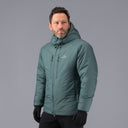
Warmth-to-weight and packability

Down wins on warmth-to-weight. An 850 fill power down jacket will typically outperform a synthetic jacket of equivalent weight. This gap narrows at lower fill powers (600–700 FP) and widens at higher ones (850+). For anyone where weight matters, such as mountaineers, alpinists, or ultralight backpackers this is the dominant consideration. For the same level of warmth, a down jacket will be lighter and more packable than its synthetic equivalent.

Down also wins clearly on packability. High fill power down compresses to a fraction of its lofted volume. A quality 850 fill power jacket stuffs down very small. Equivalent synthetic jackets are bulkier and less compressible, though modern fills have improved considerably. For travel, alpinism or any activity where you're carrying a packed jacket, this matters. For a jacket that lives on a peg and occasionally gets worn for a walk, it doesn't.

For the same level of warmth, a down jacket will be lighter and more packable than its synthetic equivalent. At 850 fill power, that gap is substantial.

The warmth-to-weight and packability advantages of down are most meaningful when the jacket is being carried rather than worn. An insulation layer that lives in the lid pocket of a rucksack until you stop moving - that's exactly the use case where down's advantages compound. If the jacket never leaves your back and never goes in a bag, both advantages become largely academic.

The Jöttnar flagship — down and synthetic in one jacket

1 | 16

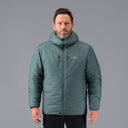
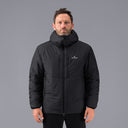
Fenrir Expedition-Grade Down Jacket


Colour
Size

Sizing charts

The measurements in the charts refer to your body measurements. Measure your body as described and then choose the corresponding product size.

Men's Sizing

Small
EUR 46 - 50
Medium
EUR 50 - 52
Large
EUR 52 - 54
X Large
EUR 54 - 56
Chest 96 - 102 cm
38 - 40 in.
102 - 106 cm
40 - 42 in.
106 - 111 cm
42 - 44 in.
111 - 116 cm
44 - 46 in.
Waist 76 - 81 cm
30 - 32 in.
81 - 86 cm
32 - 34 in.
86 - 91 cm
34 - 36 in.
91 - 96 cm
36 - 38 in.
Inside Leg 80 cm
31.5 in.
81 cm
31.9 in.
82 cm
32.2 in.
83 cm
32.7 in.


Women's Sizing

X Small
UK 6 - 8
EUR 34 - 36
US 2 - 4
Small
UK 10 - 12
EUR 36 - 38
US 6 - 8
Medium
UK 12 - 14
EUR 40 - 42
US 8 - 10
Large
UK 14 - 16
EUR 42 - 44
US 10 - 12
Bust 82 - 86.5 cm
32 - 34 in.
86.5 - 91.5 cm
34 - 36 in.
91.5 - 96.5 cm
36 - 38 in.
96.5 - 101.5 cm
38 - 40 in.
Waist 64 - 68.5 cm
25 - 27 in.
68.5 - 73 cm
27 - 29 in.
73 - 77.5 cm
29 - 31 in.
77.5 - 82.5 cm
31 - 33 in.
Low Hip 88 - 92.5 cm
34.5 - 36.5 in.
92.5 - 97.5 cm
36.5 - 38.5 in.
97.5 - 102.5 cm
38.5 - 40.5 in.
102.5 - 107.5 cm
40.5 - 42.5 in.
Inside Leg 77 cm
30.3 in.
78 cm
30.7 in.
79 cm
31.1 in.
80 cm
31.5 in.


How to measure


Measuring guide

Chest/Bust

With the tape under your armpit, measure across fullest part and across shoulder blades.

Waist

Measure around natural waistline at the narrowest part.

Low Hip

Measure around the widest part of the hip bones.

Inside leg

In a standing position, measure from top of inside leg at crotch to ankle bone.

View product

Wet weather performance and DownTek™

Wet weather performance is the most discussed difference between the two insulation types, and also the most misunderstood. Traditional, untreated down loses insulating ability when wet because the clusters collapse under moisture, destroying the air-trapping structure. A saturated traditional down jacket can lose up to 90% of its insulating value. A saturated synthetic jacket retains most of its warmth, this being the advantage synthetic has historically held.

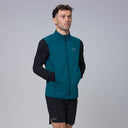
DownTek™ dramatically changes this equation. DownTek™ treated down absorbs 33% less moisture than untreated down, retains 66% more loft when wet, and dries significantly faster. All Jöttnar down jackets use DownTek™ treatment. It doesn't make down waterproof - nothing does - but it extends the performance window considerably.

Untreated down fails in under an hour of moisture exposure. DownTek™ treated down maintains performance for 1,500 minutes. The wet-weather argument against down has been substantially resolved.

There is a further practical point: if you're wearing an insulation layer as a mid-layer under a waterproof shell the insulation never gets wet from external moisture in the first place. Wet-weather performance is largely irrelevant when the layering system is correct. If you're wearing insulation as an outer layer in sustained rain without a shell, synthetic has a meaningful advantage. If you're layering properly, the advantage disappears.
For a full technical explanation of how DownTek™ works, see our separate DownTek™ guide.

Durability, care and cost

Down wins on long-term durability. High-quality goose down, properly cared for, can last decades. The clusters maintain their loft far longer than synthetic fibres, which degrade with compression and washing over time. This is not a marginal difference either - a well-made down jacket, properly maintained, will outlast multiple synthetic replacements.

However, synthetic is simpler to care for. Synthetic jackets can be machine washed with standard detergent and tumble-dried without particular care. Down requires more attention - specialist down wash is preferred, thorough drying, and the tennis ball trick to break up clumped clusters. It's not complicated, but it's additional steps.

See our separate down jacket care guide for full instructions.

The most sustainable jacket you can buy is the one that lasts the longest, which tends to favour down. Cost-per-year often favours down when considered over a full jacket lifespan.

On initial cost, synthetic can be less expensive. Quality synthetic insulation costs less to produce than high fill power goose down, and retail prices reflect this. However, given down's greater longevity, the cost-per-year calculation frequently favours down when considered over a jacket's full lifespan.

On sustainability, neither material is straightforwardly better. Down is natural and biodegradable, but welfare concerns around live-plucking and force-feeding have historically been legitimate issues. The Responsible Down Standard (RDS) addresses this, auditing supply chains to verify ethical sourcing. All Jöttnar down is RDS-compliant, fully traceable and non live-plucked. Synthetic is derived from petrochemicals and is not biodegradable, though recycled fills made from post-consumer plastic significantly reduce the environmental footprint.
The hybrid approach

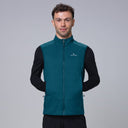
A third option exists that the down vs synthetic debate often ignores: hybrid insulation, which uses both within the same garment. The thinking is sound. Down excels at core warmth. Synthetic performs better in high-moisture zones such as the cuffs and collar where perspiration and external moisture are most likely to compromise insulation, and in shoulders where down can become compressed under rucksack straps. A hybrid jacket applies each material where it does the job best.
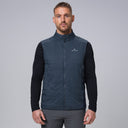
The Jöttnar Fenrir uses exactly this approach - 850 fill power DownTek™ goose down through the body, with synthetic insulation body-mapped to cuffs, collar and shoulders. The result isn't a compromise between down and synthetic performance; it's both materials performing optimally in their respective roles.

The hybrid approach makes the binary down vs synthetic choice largely obsolete for premium technical outerwear. Each material does the job it's best suited for.

This is increasingly the approach taken by serious mountain jacket design. If you're choosing between down and synthetic for a technical jacket and the choice feels difficult, it's worth asking whether a hybrid design resolves the tension entirely.

When to choose each… and the real-world verdict

Choose down when weight is a priority and you're carrying the jacket in a pack; when you're layering under a waterproof shell in damp conditions; in cold, dry conditions such as winter mountaineering or alpine use; when you want maximum packability; when long-term durability matters; or for high-altitude and extreme cold applications.

Choose synthetic when you'll be wearing the jacket as an outer layer in sustained wet conditions; in high-output activities where you'll generate significant internal moisture; when budget is a primary constraint; when simpler care is a priority; or if you have ethical objections to animal-derived materials.

If you spend time in cold British or Alpine mountain environments: buy a down jacket with hydrophobic treatment and wear it under a shell in serious conditions. The wet-weather argument against doing so I much less compelling where DownTek™ is used.

The most honest answer: the right insulation is the one that matches your actual use case. If you're buying one insulation jacket and you move through serious mountain terrain in variable conditions, a DownTek™-treated down jacket worn under a shell will outperform a synthetic alternative on virtually every metric that matters. If you're buying a jacket specifically to wear in sustained rain, or cannot realistically guarantee your down jacket won’t be exposed to heavy rain, or you do high-output activities with significant internal moisture, consider synthetic or a hybrid design.

The Jöttnar insulation range

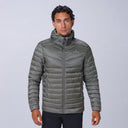
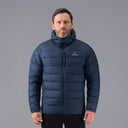
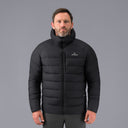
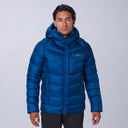
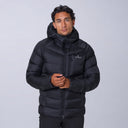
Fenrir Expedition-Grade Down Jacket

£329.00
Regular price £329.00

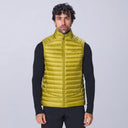
Asta Lightweight Down Gilet

£269.00
Regular price £269.00

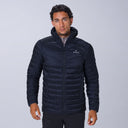
Thorne Down Jacket

£299.00
Regular price £299.00

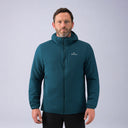
Ravn Severe Weather Insulated Jacket

£389.00
Regular price £389.00

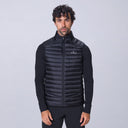
Asger-HS Polartec® Alpha™ Jacket New Release

£269.00
Regular price £269.00

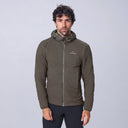
Floyen Hooded Midweight Insulated Jacket

£289.00
Regular price £289.00

Glossary

Fill Power
Volume (cubic inches) one ounce of down occupies when fully lofted. Quality metric.
Fill weight
Total mass of down in a jacket (grams). Combined with fill power determines warmth.
Hydrophobic down
Down treated with a moisture-resistant coating to reduce water absorption and maintain loft in damp conditions.
DownTek™
PFC-free hydrophobic treatment applied to individual down clusters.
Warmth-to-weight ratio
The amount of insulation a material provides relative to its weight. Down outperforms synthetic at high fill powers.
RDS
Responsible Down Standard. Certification confirming ethical sourcing.
Hybrid insulation
A jacket construction that uses both down and synthetic insulation, each placed in the zones where it performs best.
Body-mapped
A construction approach where different insulation materials or quantities are placed in different zones of a jacket according to performance requirements.