Merino vs Synthetic Base Layers: Which Is Right for You?

A Jöttnar technical guide

Merino vs Synthetic Base Layers: Which Is Right for You?

Merino or synthetic base layer? The comparison - warmth when wet, odour, durability and ethics.

The merino vs synthetic debate is one of the oldest in outdoor clothing. Both have genuine advantages. Both have genuine limitations. Most guides tell you merino is better for comfort and synthetic is better for high-output activity, and leave it there.

That's broadly true but it misses the nuance, particularly for wet weather mountain use, where the wet-warmth question matters more than in drier climates, and where multi-day trips in variable conditions put base layers under a different kind of stress. This guide goes through every performance variable honestly.

What a base layer is actually doing

Before comparing materials, it helps to be clear about what a base layer is for. Its job is not just warmth - it is moisture management. The base layer sits against your skin and must move perspiration away from your body efficiently. If it doesn't, you get wet from the inside rather than the outside, and wet clothing conducts heat away from the body roughly 25 times faster than dry clothing.

A base layer that insulates you while wet but traps moisture next to your skin will eventually make you colder than no base layer at all. This is why cotton is not a good choice as a base layer for any serious outdoor activity. Cotton absorbs moisture and holds it, functioning as an efficient cooling system once wet. Both merino and synthetic are genuinely effective at moisture management, but they go about it differently.

Wet clothing conducts heat away from the body roughly 25 times faster than dry clothing. A base layer's primary job is not just warmth, it is keeping moisture moving away from your skin.

Understanding this distinction reframes the merino vs synthetic question correctly. The two materials are not competing to be the warmest fabric, rather they are competing to manage moisture most effectively for a given activity and condition. Neither is objectively superior at this job. Each is better suited to different patterns of exertion and different weather.

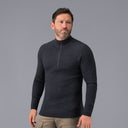
Merino wool: how it works, fibre quality, and ethical sourcing

Merino wool comes from Merino sheep, originally bred in Spain and now farmed primarily in Australia and New Zealand. The wool fibres are finer than standard wool - typically in the 15–24 micron range - which is what makes them soft enough to wear next to skin without the itching associated with coarser wools. Fibre diameter is the single most important quality variable in merino, and it varies enormously across what gets sold as "merino" in the market.

Not all merino is equal. Ultrafine merino, at 15–17 microns, is extremely soft but expensive and less durable. Extrafine merino, at 17–19 microns, delivers premium softness with genuinely good durability and this is the grade that performs well for repeated outdoor and mountain use. Fine merino, at 19–21 microns, is broadly comfortable and widely available. Standard merino, at 21–24 microns, can cause mild itching for sensitive skin. Jöttnar uses extrafine merino in the 17–19 micron range, specifically because it delivers the next-to-skin softness that makes a base layer genuinely comfortable for a full day's wear, with the durability needed for repeated mountain use. Budget merino base layers use coarser fibres, which can cause the itching that has historically put people off wool base layers entirely.

Fibre diameter is the single most important quality variable in merino. Jöttnar uses extrafine merino at 17–19 microns, the grade that delivers genuine next-to-skin softness with the durability mountain use demands.

Sourcing matters as much as fibre grade. Merino farming has historically had animal welfare concerns, particularly around mulesing, a surgical procedure performed on some merino sheep without anaesthetic. Independent welfare standards now address this directly. The ZQ and ZQRX standards and the Responsible Wool Standard (RWS) both prohibit mulesing and audit farms against animal welfare criteria covering the Five Freedoms - freedom from hunger and thirst, discomfort, pain and disease, fear and distress, and freedom to express normal behaviour. Jöttnar sources merino exclusively from certified non-mulesed, welfare-audited farms. This is not a default industry position, it is a sourcing decision we make deliberately, and one worth knowing about before you buy a merino base layer from any brand.

The flagship Jöttnar base layer

1 | 12

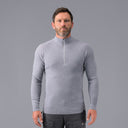
Heimdall Extrafine Merino Baselayer


Colour
Size

Sizing charts

The measurements in the charts refer to your body measurements. Measure your body as described and then choose the corresponding product size.

Men's Sizing

Small
EUR 46 - 50
Medium
EUR 50 - 52
Large
EUR 52 - 54
X Large
EUR 54 - 56
Chest 96 - 102 cm
38 - 40 in.
102 - 106 cm
40 - 42 in.
106 - 111 cm
42 - 44 in.
111 - 116 cm
44 - 46 in.
Waist 76 - 81 cm
30 - 32 in.
81 - 86 cm
32 - 34 in.
86 - 91 cm
34 - 36 in.
91 - 96 cm
36 - 38 in.
Inside Leg 80 cm
31.5 in.
81 cm
31.9 in.
82 cm
32.2 in.
83 cm
32.7 in.


Women's Sizing

X Small
UK 6 - 8
EUR 34 - 36
US 2 - 4
Small
UK 10 - 12
EUR 36 - 38
US 6 - 8
Medium
UK 12 - 14
EUR 40 - 42
US 8 - 10
Large
UK 14 - 16
EUR 42 - 44
US 10 - 12
Bust 82 - 86.5 cm
32 - 34 in.
86.5 - 91.5 cm
34 - 36 in.
91.5 - 96.5 cm
36 - 38 in.
96.5 - 101.5 cm
38 - 40 in.
Waist 64 - 68.5 cm
25 - 27 in.
68.5 - 73 cm
27 - 29 in.
73 - 77.5 cm
29 - 31 in.
77.5 - 82.5 cm
31 - 33 in.
Low Hip 88 - 92.5 cm
34.5 - 36.5 in.
92.5 - 97.5 cm
36.5 - 38.5 in.
97.5 - 102.5 cm
38.5 - 40.5 in.
102.5 - 107.5 cm
40.5 - 42.5 in.
Inside Leg 77 cm
30.3 in.
78 cm
30.7 in.
79 cm
31.1 in.
80 cm
31.5 in.


How to measure


Measuring guide

Chest/Bust

With the tape under your armpit, measure across fullest part and across shoulder blades.

Waist

Measure around natural waistline at the narrowest part.

Low Hip

Measure around the widest part of the hip bones.

Inside leg

In a standing position, measure from top of inside leg at crotch to ankle bone.

View product

Synthetic base layers: how they work, and the ethics of anti-odour treatment

Synthetic base layers use polyester or polyester-blend fabrics engineered to wick moisture away from the skin by capillary action, moving liquid water along the fibre surface from the warm side, next to skin, to the cooler outer surface where it evaporates. This is fundamentally different from how merino manages moisture, which absorbs vapour into the fibre itself rather than moving liquid along the surface. Modern synthetics have become very sophisticated. Grid-back constructions increase surface area for faster moisture transfer. Stretch fibres such as elastane improve fit and freedom of movement. The technology has genuinely advanced and synthetic base layers today perform considerably better than they did a decade ago.

Synthetic's historical weakness has been odour. Unlike merino, synthetic fibres have no inherent anti-microbial property, and the warm, moist environment inside a synthetic base layer is an effective breeding ground for the bacteria that cause body odour. Anti-odour treatments, such as Polygiene address this directly. A permanent, bluesign-approved antimicrobial finish based on recycled silver salts is applied during manufacture rather than as a surface coating that washes away.

Polygiene treatment uses recycled silver salts, is bluesign-approved, and contains no PFCs. The silver content required is tiny, the equivalent of one silver ring produces enough material for around 5,000 garment treatments.

The ethics and safety of the treatments we use, such as Polygiene, are independently verified. The silver salt chemistry is bluesign-approved, meeting rigorous independent environmental and consumer safety standards for textile manufacturing, and is also Oeko-Tex certified and REACH compliant, the EU's chemical safety legislation. It contains no PFCs, PFOA or PFOS. The treatment works by disrupting bacterial cell walls on contact, preventing the odour-causing bacteria from establishing in the fabric, and it remains effective for the working lifespan of the garment rather than degrading after a handful of washes. There is also a genuine environmental upside: because treated garments need washing less frequently, independent lifecycle assessment of Polygiene-treated garments has shown reductions in water and energy use over a garment's life. We chose this specific treatment for both its performance and its safety and environmental profile even though it’s not the cheapest option available.

Moisture management and warmth when wet

In high-output, sustained activity such as long continuous uphill sections, ski touring approaches, and trail running, synthetic wicks faster and dries faster, making it the better performer when effort is continuous. In variable, stop-start activity, the normal pattern of hillwalking, mountaineering and downhill skiing, merino tends to win. Merino absorbs moisture into the fibre without feeling wet, buffering the transition between moving and stationary, so you avoid the sudden clammy sensation synthetic can produce the moment you stop moving. Both materials are genuinely effective at
moisture management; the difference is which pattern of activity each suits best.

Warmth when wet makes the choice more significant than it would be in a drier climate. Merino retains good insulating ability when damp as the fibre structure continues to trap air even while absorbing moisture, so a wet merino base layer will still keep you warmer than no base layer at all. Synthetic loses insulating ability faster when saturated. It dries faster once the rain stops, but in sustained wet conditions such as rain on top of sweat, (which is the default British mountain scenario.), that drying advantage is less relevant if the layer never gets the chance to dry.

Much mountain weather is wet, cold and changeable. A layer that keeps working when damp suits this environment better than one optimised for rapid drying in conditions that never arrive.

This is one of the clearest practical distinctions when choosing merino or synthetic base layers. If your mountain use is predominantly in drier climates, say the Alps in settled summer weather, the synthetic drying advantage becomes more relevant. For unsettled conditions, where the weather rarely cooperates for long, merino's ability to keep performing while damp is the more useful property for most people.

Odour resistance, durability and cost

On odour, merino wins clearly. Merino fibres have a natural antimicrobial property that inhibits the growth of odour-causing bacteria, meaning a merino base layer can be worn for multiple consecutive days without developing significant odour. This is not marketing; it is a genuinely useful property for multi-day mountain trips, where carrying fewer base layers means a pack weight saving, and not needing to wash or dry a layer mid-route removes a logistical headache. Polygiene-treated synthetic narrows the gap, but doesn't fully replicate merino's natural performance over very long multi-day use.

On durability, synthetic wins. Merino fibres are finer than synthetic fibres and more susceptible to abrasion and mechanical stress, particularly at points of friction such as pack strap contact, seams under harness webbing, and repeated washing. A high-quality merino base layer, properly cared for, can still give years of good service, but under equivalent hard use it will not outlast an equivalent-quality synthetic layer. Merino blends substantially improve durability while retaining the merino's performance characteristics, for example the Jöttnar Mar uses a merino blend specifically to combine merino's comfort and odour resistance with improved durability.

A merino blend combines merino's comfort and natural odour resistance with synthetic's durability under abrasion.

On cost, synthetic is cheaper to produce. Budget merino exists but tends to use lower-quality, coarser fibre with reduced performance, reduced next-to-skin comfort and reduced longevity. Comparing a budget merino product to a quality synthetic one isn't a fair test and the price gap narrows once you compare equivalent quality tiers. Given synthetic's durability advantage, the cost-per-wear calculation will often still favour synthetic over a long ownership period under hard use. Where merino earns back ground is in how much you actually want to wear it: its comfort and odour resistance mean it tends to get worn more often relative to a wardrobe of alternatives, which is a different kind of value than raw durability. Neither material is straight forwardly cheaper once both performance and lifetime use are accounted for. Neither material is straightforwardly more sustainable either. Merino is natural and biodegradable but has a land and water farming footprint; synthetic is derived from petrochemicals, is not biodegradable, and sheds microplastic fibres during washing. The most genuinely sustainable choice, in practice, is the layer that lasts longest and gets used the most.

Which should you choose?

.Weight is the other major variable, and it applies regardless of which material you choose. Base layer weight is measured in grams per square metre (gsm). Higher numbers mean a thicker, warmer fabric. As a rough guide: 120–150gsm is lightweight, 3-season wear suited to warm weather, high-output activity and travel. 150–200gsm is midweight, 3–4 season wear and the right range for most mountain use, general walking and scrambling, and downhill skiing. 200–260gsm is heavyweight, winter wear for static or low-output cold exposure such as winter camping, belaying, or very cold-weather downhill skiing.

That said, treat these bands as a starting point, not a rule. Temperature tolerance varies enormously between individuals, and your own experience matters more than the gsm number on a label. Some people ‘run cold’ and want a heavier weight even in moderate conditions; others ‘run hot’ and rarely need to go above 150gsm except in genuinely severe cold, say minus 15°C and below. The right weight is the one that works for your body in practice, not the one the gsm chart suggests for the conditions on paper.

Neither material is objectively superior. The right choice depends on your activity pattern and the conditions you'll actually face.

Choose merino if comfort over a full day's wear is a priority, if you do multi-day trips and want to carry fewer layers, if your activity is stop-start in changeable conditions, if unsettled weather mountain use is your primary context, or if long-term investment matters more than initial cost. Choose synthetic if you do sustained high-output activity where rapid wicking is the priority, if you need the fastest-drying option, if durability under repeated abrasion is critical, or if budget is a primary constraint. Choose a blend if you want merino's comfort and odour resistance with improved durability, if your activity spans a mix of types, or if you want a single layer that performs well across most scenarios rather than excelling in one.

For most people doing the majority of their walking, scrambling and mountaineering in the UK pr the Alps, as well as for downhill skiing, extrafine merino is the right starting point. Its warmth-when-wet performance and odour resistance suit the conditions most people actually encounter most often. For sustained high-output training, trail running or single day ski touring where rapid wicking matters more than multi-day comfort, synthetic is the more rational choice.

A final point on quality regardless of which material you choose: always check the specification, not just the material name. "Merino" alone tells you very little. Ask for the fibre micron count, and treat anything described only as "merino blend" with appropriate scrutiny over the actual percentage. "Synthetic" alone tells you little either. Ask whether an odour treatment is used, and whether it's a bluesign-approved, PFC-free chemistry of the kind described in this guide. The material category matters less than the quality and ethics behind the specific product.

The Jöttnar base layer range

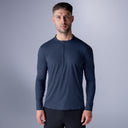
Heimdall Extrafine Merino Baselayer

£149.00
Regular price £149.00

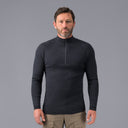
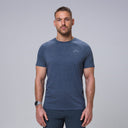
Bris Half Zip Baselayer 30% off

£55.00
Regular price £79.00 Minimum price £55.00

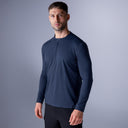
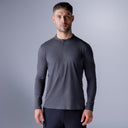
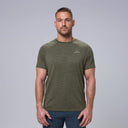
Mar Extrafine Merino T-Shirt New Release

£79.00
Regular price £79.00

Glossary

Micron (µm)
The unit used to measure wool fibre diameter. Lower numbers mean finer, softer fibres. Extrafine merino is 17–19 microns.
Extrafine merino
Merino wool in the 17–19 micron range, delivering premium softness with good durability for repeated technical use.
Hygroscopic
A material property describing the ability to absorb moisture vapour into the fibre structure without feeling wet to the touch.
Capillary action
The process by which synthetic fibres move liquid water along the fibre surface, used to wick sweat away from the skin.
Mulesing
A surgical procedure historically performed on some merino sheep without anaesthetic. Prohibited under ZQ, ZQRX and Responsible Wool Standard certifications.
ZQ / ZQRX
Independent merino wool certification standards auditing farms against animal welfare criteria and prohibiting mulesing.
Responsible Wool Standard (RWS)
An independent certification verifying wool is sourced from farms meeting defined animal welfare and land management criteria.
Polygiene
A permanent, bluesign-approved antimicrobial textile treatment based on recycled silver salts, used to control odour in synthetic fabrics.
Bluesign®
An independent certification verifying that chemistry and manufacturing processes meet environmental and safety standards in textile production.
Cotton kills
A mountaineering principle describing cotton's tendency to absorb and retain moisture, making it dangerous as a base layer in cold, wet conditions.