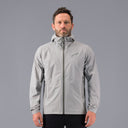
Hardshell Jacket Guide: What to Look For

A Jöttnar technical guide

Hardshell Jacket Guide: What to Look For

How to choose a hardshell jacket - waterproofing ratings, breathability, membranes, 2-layer vs 3-layer and key features explained.

A hardshell jacket is one the most technically complex pieces of clothing in outdoor layering. It has to do several things simultaneously that are, in engineering terms, in direct conflict with each other: keep water out whilst also letting internal moisture out, built to withstand sustained wind and rain while remaining packable, and perform in conditions ranging from mountain drizzle to a full snow storm.

Getting it right requires understanding what the numbers and terminology actually mean - not the marketing version, the real version. This guide explains it.

What a hardshell jacket actually does

A hardshell jacket is a fully waterproof, windproof outer layer and is the definitive last line of defence against the weather. Unlike a softshell, which offers some water resistance but will eventually wet through, or an insulated jacket, which provides warmth but is not a primary rain barrier, a hardshell is designed as the outermost layer of a complete layering system. Its job is weather protection, not warmth.

The defining characteristics of a hardshell are: a fully waterproof membrane that prevents external liquid water from passing through; fully taped seams that seal the needle holes left by stitching; windproofing; and breathability - the ability to allow water vapour from perspiration to escape outward while preventing liquid water from entering. That last point is where the engineering challenge lies. The same membrane that blocks liquid water must allow vapour to pass through. The more effectively it does this, the better the jacket performs during sustained high-output activity in bad weather.

A hardshell's job is weather protection, not warmth. Warmth comes from the layers beneath it. The hardshell's job is to keep those layers dry and the wind out so they can do their jobs.

A hardshell worn as an outer layer over a down or synthetic mid-layer is the standard layering approach for outdoor use. The hardshell does not need to be warm; it needs to be waterproof, breathable and durable. Understanding this distinction is the most useful starting point for any hardshell buying decision. If you are looking for a jacket that does everything in one, a hardshell is not what you want.

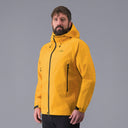
Shell fabric explained: membranes, construction and DWR

The waterproof membrane is the functional heart of a hardshell. It is a thin film, typically expanded polytetrafluoroethylene (ePTFE) or polyurethane (PU), bonded to the face fabric. The membrane contains microscopic pores that are large enough to allow water vapour molecules to pass through from the inside (breathability) but small enough to prevent liquid water droplets from penetrating from the outside (waterproofing). How that membrane is constructed and bonded determines the jacket's durability, packability and performance profile.

Two-layer (2L) construction bonds the membrane to the outer face fabric only, with a separate hanging mesh liner protecting the membrane from abrasion on the inside. Softer and more comfortable next to insulation layers, but heavier and less durable under sustained abrasion. Common in casual and budget hardshells.

Two-and-a-half layer (2.5L) construction bonds the membrane to the outer fabric and replaces the inner liner with a printed or embossed pattern. Lightweight and packable, but less durable. Good for ultralight applications where weight is the primary constraint.

Three-layer (3L) construction bonds the membrane to both the outer face fabric and an inner face fabric, creating a single laminated construction. More durable, more structured, and better performance under the abrasion of rucksack straps, harnesses and sustained outdoor use.

The DWR finish on the outer fabric matters as much as the membrane rating. Without a functioning DWR, even a high-rated jacket will feel wet and clammy as the outer fabric saturates, blocking breathability from the inside.The DWR finish on the outer fabric matters as much as the membrane rating. Without a functioning DWR, even a high-rated jacket will feel wet and clammy as the outer fabric saturates, blocking breathability from the inside.

The DWR (Durable Water Repellent) finish is a separate treatment applied to the outer face fabric that causes water to bead and run off rather than soaking into the fabric. DWR does not affect waterproofing - the membrane handles that - DWR is present to help with breathability. When the outer fabric saturates (a condition called 'wetting out'), it blocks the membrane's ability to transmit vapour outward, causing the jacket to feel clammy from the inside even though it is not leaking. Refreshing DWR regularly is essential maintenance: a warm tumble dry is often sufficient to reactivate it, although specialist spray-on treatments can also be used.

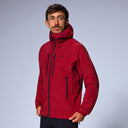
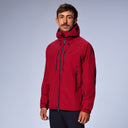
Face fabric weight, measured in denier (D), affects abrasion resistance. Lighter facefabrics (20D and below) save weight but are more susceptible to damage from crampon points, rock abrasion, pack straps and general use. Heavier face fabrics (40D–75D) add weight but significantly extend the jacket's working life. For example, at Jöttnar, the Grim jacket uses a 75D face fabric specifically for durability under all-mountain use.

The Jöttnar all-mountain hardshell

1 | 19

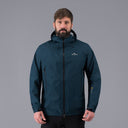
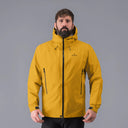
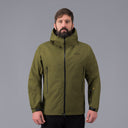
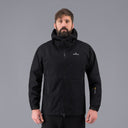
Grim All-Mountain Hardshell Jacket


Colour
Size

Sizing charts

The measurements in the charts refer to your body measurements. Measure your body as described and then choose the corresponding product size.

Men's Sizing

Small
EUR 46 - 50
Medium
EUR 50 - 52
Large
EUR 52 - 54
X Large
EUR 54 - 56
Chest 96 - 102 cm
38 - 40 in.
102 - 106 cm
40 - 42 in.
106 - 111 cm
42 - 44 in.
111 - 116 cm
44 - 46 in.
Waist 76 - 81 cm
30 - 32 in.
81 - 86 cm
32 - 34 in.
86 - 91 cm
34 - 36 in.
91 - 96 cm
36 - 38 in.
Inside Leg 80 cm
31.5 in.
81 cm
31.9 in.
82 cm
32.2 in.
83 cm
32.7 in.


Women's Sizing

X Small
UK 6 - 8
EUR 34 - 36
US 2 - 4
Small
UK 10 - 12
EUR 36 - 38
US 6 - 8
Medium
UK 12 - 14
EUR 40 - 42
US 8 - 10
Large
UK 14 - 16
EUR 42 - 44
US 10 - 12
Bust 82 - 86.5 cm
32 - 34 in.
86.5 - 91.5 cm
34 - 36 in.
91.5 - 96.5 cm
36 - 38 in.
96.5 - 101.5 cm
38 - 40 in.
Waist 64 - 68.5 cm
25 - 27 in.
68.5 - 73 cm
27 - 29 in.
73 - 77.5 cm
29 - 31 in.
77.5 - 82.5 cm
31 - 33 in.
Low Hip 88 - 92.5 cm
34.5 - 36.5 in.
92.5 - 97.5 cm
36.5 - 38.5 in.
97.5 - 102.5 cm
38.5 - 40.5 in.
102.5 - 107.5 cm
40.5 - 42.5 in.
Inside Leg 77 cm
30.3 in.
78 cm
30.7 in.
79 cm
31.1 in.
80 cm
31.5 in.


How to measure


Measuring guide

Chest/Bust

With the tape under your armpit, measure across fullest part and across shoulder blades.

Waist

Measure around natural waistline at the narrowest part.

Low Hip

Measure around the widest part of the hip bones.

Inside leg

In a standing position, measure from top of inside leg at crotch to ankle bone.

View product

Waterproofing and breathability: what the numbers mean

Waterproofing is measured using a hydrostatic head test, measured in millimetres. A column of water is placed above a sample of fabric and the height of the column at the point at which water begins to pass through is recorded. The higher the number, the more waterproof the fabric under pressure.

For outdoor and mountain use in British or Alpine conditions, a minimum of 20,000mm is necessary. A caveat: hydrostatic head is a standardised lab test under static pressure, not a real-world performance guarantee. Seam sealing quality, DWR condition and construction all affect real-world performance as much as the membrane rating.

Breathability is measured in one of two ways. MVTR (Moisture Vapour Transmission Rate) is expressed in grams per square metre per 24 hours. Higher numbers mean more breathable. Above 15,000g/m²/24hr is considered highly breathable; above 20,000g/m²/24hr is excellent for sustained active use. RET (Resistance to Evaporative Transfer) works inversely and a lower number is better. Below 6 RET is very breathable; below 13 RET is acceptable for moderate activity. When comparing jackets, check which measurement is being used and compare like for like.

In sustained high-output activity in rain, an insufficiently breathable jacket leaves you as wet from sweat as you would have been from rain. Breathability is not just a comfort metric; it is a performance and safety metric.

Why breathability matters as much as waterproofing: in sustained high-output activity such as climbing, ski touring, trekking and trail running in rain an insufficiently breathable jacket causes internal moisture to condense against the inner face fabric. The result is a jacket that is wet on the inside despite being waterproof on the outside. This reduces the insulating ability of any mid-layer worn beneath it, increases the risk of chilling when exertion stops, and significantly reduces comfort over a long day. For anyone spending time outdoors under effort, breathability is not a secondary consideration. It is as important as the waterproof rating.

Key features: what to look for and why each matters

The hood: the hood is the single most important feature on a mountain hardshell after the membrane itself. A poor hood is the primary failure point for weather protection in serious conditions as it gaps, collapses in wind, or restricts peripheral vision at the moment when awareness of the terrain matters most. Look for: helmet compatibility (the hood must fit over a climbing or ski helmet without restricting movement or vision); a wire peak or stiffened brim that maintains its shape in wind and prevents collapse over the face; full peripheral vision when the hood is cinched - you should be able to turn your head with the hood rotating with it; and single-hand adjustability so the hood can be tightened while wearing gloves. A hood that requires two hands and dexterity to adjust is not a mountain hood.

Seam sealing: all critical seams in a serious hardshell should be fully taped. Some budget hardshells use critically-sealed seams with only the most exposed seams being taped in order to reduce cost. In sustained rain, untaped seams will eventually allow water ingress at the needle holes. Full seam sealing is non-negotiable for us.

Pit zips: underarm ventilation zips allow rapid heat dumping during high-output activity without removing the jacket. Useful for ski touring, winter climbing approaches, and any activity with significant variation between exertion and rest. They are not universal and some lighter jackets omit them to save weight, which is a valid trade-off for fast-and-light applications - for example trail running.

A fully featured hardshell with a proper helmet-compatible hood, full seam sealing, durable face fabric, velcro sealed cuffs, Recco avalanche transponder system, and pit zips will sit between 400g and 700g. That weight is there for a reason.

Pockets: Jöttnar hardshells are designed so both hand and chest pockets remain accessible when wearing a harness or a rucksack hip belt. Internal pockets keep phones, maps and food dry.

Waterproof zippers: prevent water tracking along zip pulls - a premium detail that matters in sustained rain.

Hem and cuffs: adjustable hem and cuffs seal the jacket against wind and rain ingress. Internal elastic cuffs with velcro adjustment are more durable than velcro-only cuffs.

Hem: A drop hem at the back provides additional coverage when bending or reaching.

Weight considerations: A trail running shell can be as light as 250g and remain fully functional for its intended use. A fully featured hardshell with a proper helmet-compatible hood, full seam sealing, durable face fabric, velcro sealed cuffs, Recco avalanche transponder system, and pit zips will sit between 400g and 700g. That weight is there for a reason. If you're choosing a jacket for anything involving crampon points, rock, ice tools, and pack and general abrasion, the 250g option is not the right tool. The weight you save on the approach you may pay for on the mountain.

Weight vs durability - and hardshell vs softshell vs windshell

Getting the weight-durability balance right depends entirely on intended use. Trailrunning and fastpacking favour jackets under 200g - thin face fabrics, minimal features, packable to almost nothing. The trade-off is durability: these jackets are not designed to survive repeated abrasion from rock, ice, harnesses or pack straps. General hillwalking and trekking sits in the 300–500g range, balancing packability and durability. Technical mountaineering and alpine use requires 400–600g or above, prioritising durability and feature set. A jacket that fails in the mountains has a different cost than one that fails on a trail.

Hardshell vs softshell vs windshell: these are complementary categories, not competing ones, and a complete mountain wardrobe often includes all three. A hardshell is the definitive outer layer for sustained rain, snow and serious mountain weather - fully waterproof, fully seam-sealed, the primary weather barrier. A softshell is water-resistant but not waterproof. It offers more breathability and flexibility than a hardshell and excels in high-output activity in changeable but predominantly dry conditions: ski touring approaches, winter climbing on dry days, trekking in light drizzle. It is not a substitute for a hardshell in sustained rain. A windshell is windproof with minimal water resistance and maximum breathability - the right choice in dry, windy conditions, or sustained trail running where wind protection and ventilation are the primary requirements, not rain defence.

A softshell is not a hardshell in good conditions. It is a different tool for a different job — more breathable, more flexible, less weather-resistant.

The practical question for any hardshell buying decision: what conditions is this jacket going to see, and what is the cost of it failing? For a typical mostly dry day's walk in the Brecon Beacons, ski-touring or downhill skiing in sunny conditions, a softshell may be entirely adequate. For a winter ascent in the Cairngorms, or an alpine route with the threat of poor weather, the specifications - membrane rating, breathability, face fabric denier, seam sealing, hood quality - all need to be at the top of the range. The mountain does not grade on a curve.

How to choose: a practical framework

The right hardshell is the one that matches the conditions it will actually face. Start with use case: if your mountain use is predominantly hillwalking and trekking in UK conditions, a jacket with 20,000mm+ waterproofing, good breathability and 3-layer construction at around 350–450g covers the ground well. If your use extends to technical winter climbing, ski touring, downhill skiing or alpine routes, move to the top of the specification range. If weight is your primary constraint for trail running or fast-and-light alpinism, accept the durability trade-off consciously and choose a jacket with the lightest face
fabric the activity will tolerate.

A few questions worth asking when comparing jackets: is the seam sealing full or critical? What is the face fabric denier? Is the DWR PFC-free? Does the hood fit over a helmet? How are pockets placed? Does it have pit zips? Avalanche safety features? These questions cut through the marketing and get to the specification that determines real-world performance. A jacket that answers all of them well at your budget is the right jacket.

The mountain does not grade on a curve. The right hardshell specification is determined by the worst conditions you will face in it — not the average ones.

Quick reference on the key decisions. Construction: 3-layer for optimum performance. Waterproofing: 20,000mm+ for mountain use. Breathability: 15,000g MVTR or above for active use. Face fabric: 60D+ for technical use, lighter for trail and fastpacking. Seam sealing: full taping across all seams. Hood: helmet-compatible with wire peak and single-hand adjustment if helmets are worn. DWR: PFC-free chemistry as standard. Weight: matched to use case and not minimised at the expense of durability where durability matters.

The Jöttnar hardshell range

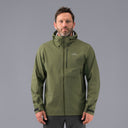
Grim All-Mountain Hardshell Jacket

£549.00
Regular price £549.00

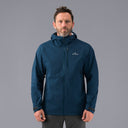
Asgard Expedition Grade Hardshell Jacket

£649.00
Regular price £649.00

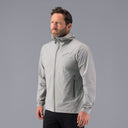
Midgard Lightweight Hardshell Jacket

£449.00
Regular price £449.00

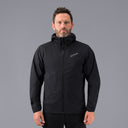
Isleif Ultralight Hardshell Jacket

£359.00
Regular price £359.00

Glossary

Hydrostatic head
The waterproofing rating of a fabric, measured in millimetres. Indicates the height of a water column the fabric can withstand before water passes through.
MVTR
Moisture Vapour Transmission Rate. A breathability measurement expressed in grams per square metre per 24 hours. Higher numbers mean more breathable.
RET
Resistance to Evaporative Transfer. An alternative breathability measurement where lower numbers indicate better breathability.
DWR
Durable Water Repellency. A treatment applied to fabrics or insulation to resist moisture absorption.
Membrane
The thin waterproof and breathable film at the core of a hardshell jacket, bonded to the face fabric. Prevents liquid water from entering while allowing water vapour to escape.
3-layer construction
A hardshell construction where the membrane is bonded to both the outer face fabric and an inner face fabric, creating a single laminated layer. Most durable construction.
2.5-layer construction
A hardshell construction where the membrane is bonded to the outer face fabric with a printed inner surface replacing a separate liner. Lightweight but less durable.
Seam sealing
Tape applied over stitched seams to prevent water ingress through needle holes. Full seam sealing means all seams are taped.
Denier (D)
A measure of face fabric weight and thickness. Higher denier means heavier, more abrasion-resistant fabric. Lower denier means lighter but more vulnerable to damage.
Pit zips
Underarm ventilation zippers that allow rapid heat and moisture release during high-output activity without removing the jacket.
RECCO®
A passive rescue reflector system embedded in technical garments, detectable by helicopter-mounted search equipment in avalanche rescue scenarios.
Wetting out
When the DWR finish degrades and the outer face fabric absorbs water rather than shedding it, reducing breathability from the inside.